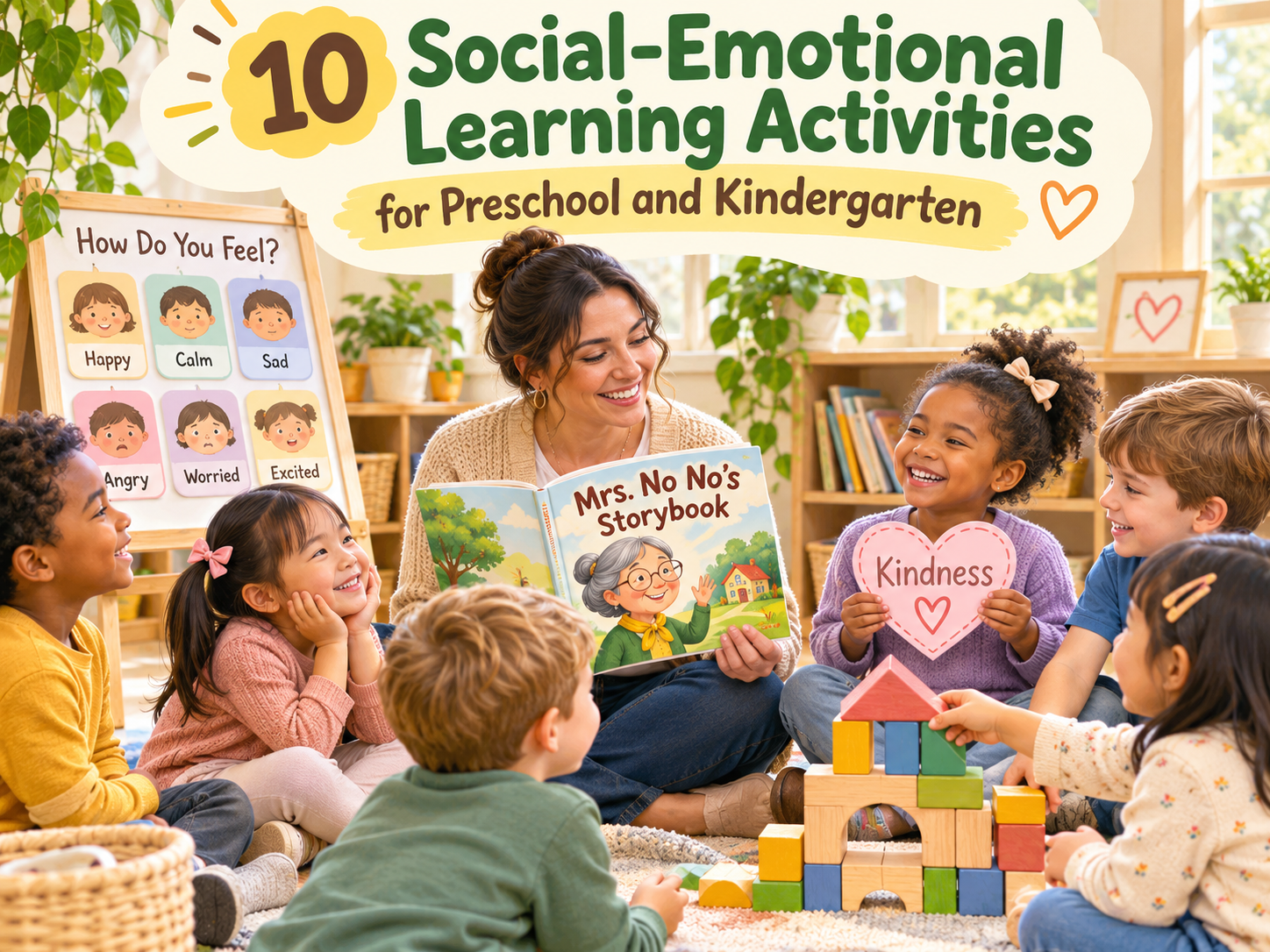
What if just 10 minutes of play, storytelling, or conversation could help children practice kindness, understand feelings, and make more thoughtful choices?
Imagine a preschool classroom where children are learning how to express frustration without hurting others, offer comfort to a friend, and work together to solve problems.
These skills don't develop overnight. Like learning letters, counting, or recognizing colors, social-emotional skills need opportunities for practice, encouragement, and guidance.
That's why social-emotional learning activities are an important part of early childhood education.
Whether you're a preschool teacher, kindergarten educator, special education professional, or parent, simple activities can help children explore emotions, strengthen friendships, and practice positive behavior.
The best part? You don't need expensive materials or complicated lesson plans.
In this guide, you'll discover 10 fun, engaging social-emotional learning activities for preschool and kindergarten, including step-by-step instructions, classroom examples, and teaching tips you can use immediately.
What Is Social-Emotional Learning (SEL) for Preschoolers?
Social-emotional learning (SEL) is the process of helping children understand emotions, manage their responses, develop empathy, build healthy relationships, and make responsible decisions.
For preschool and kindergarten students, SEL happens through everyday experiences such as playing with friends, sharing toys, expressing feelings, listening to stories, and solving simple problems.
According to CASEL's SEL framework, social-emotional learning includes five interconnected competencies:
- Self-Awareness: Recognizing emotions, interests, and personal strengths.
- Self-Management: Learning ways to manage feelings, behavior, and responses.
- Social Awareness: Understanding and showing consideration for other people's feelings.
- Relationship Skills: Communicating, cooperating, and building positive relationships.
- Responsible Decision-Making: Making safe, thoughtful, and caring choices.
For young children, these concepts become easier to understand when educators use pictures, games, songs, stories, and familiar situations.
For example, a child who learns to say "I'm frustrated" instead of immediately throwing a toy is practicing emotional awareness and communication.
Likewise, a child who asks a friend, "Would you like a turn?" is practicing cooperation and relationship skills.
The purpose of preschool SEL isn't to eliminate difficult emotions. It's to give children skills and support for navigating them.
Why Are Social-Emotional Learning Activities Important for Young Children?
Children between the ages of three and six are developing important emotional, social, communication, and independence skills.
During these early years, they are learning how to interact with other children, understand classroom expectations, respond to disappointment, and express their needs.
Thoughtfully designed SEL activities create opportunities to practice those skills.
Benefits of incorporating SEL activities into everyday learning
• Emotional awareness: Children practice identifying and communicating feelings.
• Positive behavior: Children explore helpful alternatives to hitting, grabbing, or shouting.
• Friendship skills: Cooperative activities provide opportunities to practice listening, sharing, and turn-taking.
• Self-confidence: Children receive encouragement and learn to recognize their efforts.
• Empathy: Stories and discussions introduce different perspectives and experiences.
• Problem-solving: Children learn to consider safe and respectful responses to everyday challenges.
• Classroom connection: Group activities encourage relationships and a sense of belonging.
The National Association for the Education of Young Children (NAEYC) emphasizes the importance of responsive teacher-child relationships and intentional social-emotional learning experiences in early childhood settings.
These activities can also be adapted for inclusive classrooms, including children who communicate differently or benefit from visual, sensory, and individualized supports.
10 Fun Social-Emotional Learning Activities for Preschool and Kindergarten
Here are 10 practical SEL activities to introduce at home or in the classroom.
1. The Feelings Faces Game
SEL Skill: Emotional Awareness and Self-Awareness
Best for: Ages 3–6
Time needed: 5–10 minutes
Materials: Emotion flashcards, a handheld mirror, or paper and crayons.
Young children sometimes experience strong emotions without knowing how to describe them.
The Feelings Faces Game introduces emotional vocabulary in an enjoyable, interactive way.
How to Play
- Show children pictures of different facial expressions.
- Introduce words such as happy, sad, excited, frustrated, and worried.
- Invite children to match a feeling to a picture.
- Ask what situations might make someone feel that way.
- Encourage children to draw or create their own feelings faces.
Teacher Questions:
• "How do you think this person feels?"
• "What makes you feel excited?"
• "What can we do when we feel sad?"
• "Can two people feel differently about the same thing?"
Classroom Example:
During morning circle, show a picture of a surprised face.
Ask, "What might have happened to make this person feel surprised?"
Invite children to offer different possibilities.
Why It Helps: This activity gives children opportunities to recognize and name emotions in themselves and others.
Inclusive Learning Tip: Allow children to point, use picture cards, gesture, or communicate through their preferred method rather than requiring verbal answers.
2. The Kindness Jar Challenge
SEL Skill: Empathy and Relationship Building
Best for: Ages 3–6
Time needed: 5 minutes daily
Materials: A clear jar, colorful paper hearts, and crayons.
Kindness becomes easier to understand when children see examples of caring actions in everyday situations.
The Kindness Jar Challenge encourages children to notice helpful and considerate choices.
How to Play
- Place a jar in a visible classroom location.
- Explain what kindness can look like.
- Invite children to notice kind actions throughout the day.
- Add a paper heart when the class identifies an example.
- At the end of the week, discuss the different ways children showed kindness.
Examples of Kindness:
• Helping someone pick up dropped crayons.
• Inviting a classmate to join a game.
• Comforting a friend who feels sad.
• Taking care of shared classroom materials.
• Thanking someone for helping.
Teacher Questions:
• "What is one kind thing we can do today?"
• "How did it feel when someone helped you?"
• "What can we do when someone needs support?"
Why It Helps: The activity provides opportunities to recognize empathy, cooperation, and caring behavior.
Teacher Tip: Avoid ranking students by the number of hearts they earn. The goal is to build a supportive classroom community, not create competition.
3. The Calm Breathing Flower Game
SEL Skill: Self-Management and Emotional Regulation
Best for: Ages 3–6
Time needed: 3–5 minutes
Materials: A pretend flower, picture of a flower, or pinwheel.
Young children may find it difficult to follow abstract directions such as "calm down."
A playful breathing activity can introduce one possible strategy for settling their bodies.
How to Play
- Invite children to imagine holding a beautiful flower.
- Say, "Let's gently smell the flower."
- Encourage a comfortable breath in.
- Say, "Now let's slowly blow the flower's petals."
- Encourage a gentle breath out.
- Repeat a few times if the child is comfortable.
Teacher Script:
"Sometimes our feelings get really big. Let's try smelling our flower and slowly blowing the petals."
Classroom Example:
Before transitioning from outdoor play to storytime, offer a short breathing activity to help children shift to a quieter routine.
Why It Helps: Children become familiar with a simple calming technique they may choose to use when they feel overwhelmed.
Important: Never force a child to breathe in a particular rhythm or use breathing as a punishment. Some children prefer movement, quiet time, or other regulation supports.
4. The Sharing and Turn-Taking Tower
SEL Skill: Cooperation and Relationship Skills
Best for: Ages 3–6
Time needed: 10–15 minutes
Materials: Building blocks or stacking cups.
Sharing and turn-taking are important preschool skills, but they don't always come naturally.
This collaborative building game makes practicing cooperation enjoyable.
How to Play
- Place a collection of building blocks in the middle of a small group.
- Explain that everyone will work together to build one tower.
- Invite each child to add a block when it is their turn.
- Encourage children to ask for materials and support one another.
- Celebrate the group's cooperation, regardless of how tall the tower becomes.
Helpful Phrases:
• "Would you like a turn?"
• "Can I use that block when you're finished?"
• "Let's build this together."
• "Thank you for waiting."
Teacher Questions:
• "What could we do if two friends want the same block?"
• "How can we make sure everyone gets a chance?"
• "What should we do if our tower falls?"
Why It Helps: Children practice communication, patience, and cooperation while working toward a shared goal.
Inclusive Learning Tip: Offer alternative roles, such as choosing colors, pointing to blocks, or helping design the tower, so children with different motor abilities can participate.
5. Interactive Storytime: What Would You Do?
SEL Skill: Empathy, Positive Choices, and Responsible Decision-Making
Best for: Ages 3–6
Time needed: 10–15 minutes
Materials: An illustrated children's book featuring everyday social situations.
Storytelling can make social-emotional learning more relatable for young children.
Instead of telling children what they should always do, interactive reading invites them to explore situations through characters, illustrations, and gentle discussions.
How to Play
- Choose an age-appropriate story.
- Gather children in a comfortable reading area.
- Read aloud while showing the illustrations.
- Pause when a character faces an important choice.
- Ask children what the character might be feeling.
- Invite them to suggest a kind, safe, or helpful response.
- Discuss how the character's actions might affect others.
Storytime Discussion Questions:
• "How do you think the character feels?"
• "Was that a kind choice?"
• "What could the character try differently?"
• "What would you do if you were there?"
• "How could a friend help?"
Classroom Example:
Imagine a story in which one child grabs another child's toy.
Ask:
"How might the other child feel?"
Then ask:
"What could the character say if they wanted a turn?"
Encourage children to practice phrases such as:
"Can I play with that when you're done?"
Make Storytime More Meaningful With Mrs. No No's Storybook
Teachers and parents looking for a gentle way to explore positive choices can introduce Mrs. No No's Storybook by Susan W. Owens.
This illustrated children's book features Mrs. No No, a fictional character whose expressive eyes and nonverbal communication create opportunities to discuss everyday behavior, kindness, and making thoughtful choices.
Rather than using the story to criticize a child, adults can use the character as a conversation starter.
Suggested Mrs. No No Activity:
After reading a scene, ask:
"What kind choice could someone make in a situation like this?"
Invite children to share ideas, point to pictures, or act out an appropriate response.
Why It Helps: Interactive storytelling provides a comfortable way to discuss emotions, different perspectives, and decision-making.
Teacher Tip: Avoid identifying an individual child as the "bad character" during a discussion. Keep activities supportive and focused on learning.
6. The Helping Hands Friendship Activity
SEL Skill: Empathy and Social Awareness
Best for: Ages 3–6
Time needed: 10–15 minutes
Materials: Construction paper, crayons, and child-safe scissors.
Children can develop an understanding of friendship by exploring ways to help others.
This simple craft combines creativity with positive social behavior.
How to Play
- Help each child trace their hand on colored paper.
- Cut out the hand shapes using age-appropriate assistance.
- Ask children to think of a helpful action.
- Write or draw their ideas on the paper hands.
- Display the hands on a classroom friendship wall.
Examples:
• "I can help clean up."
• "I can ask a friend to play."
• "I can listen when someone talks."
• "I can help someone find their crayons."
Teacher Questions:
• "What does being a good friend mean?"
• "How can we help someone who is having a difficult day?"
• "What can we do if a friend doesn't want to play right now?"
Why It Helps: Children connect the idea of kindness with practical actions they can use in everyday relationships.
Extension Activity: At the end of the week, invite students to share examples of helpful actions they noticed, without requiring anyone to participate publicly.
7. The Feelings Freeze Dance
SEL Skill: Emotional Expression and Self-Awareness
Best for: Ages 3–6
Time needed: 10 minutes
Materials: Music and emotion picture cards.
Movement activities can help young children explore feelings in a playful, low-pressure environment.
The Feelings Freeze Dance combines music, creative expression, and emotional vocabulary.
How to Play
- Play a short piece of upbeat music.
- Invite children to dance or move comfortably.
- Pause the music.
- Hold up an emotion card.
- Invite children to express that feeling through facial expressions, movement, or gestures.
- Continue with different emotions.
Example Prompts:
• "Show me what excitement might look like."
• "What might someone do when they feel surprised?"
• "Can you show a calm, relaxed pose?"
• "How might a person move when they're feeling tired?"
Teacher Tip: Explain that emotions can look different from one person to another. There isn't always one correct facial expression or body movement.
Why It Helps: Children explore the connections between feelings, communication, and body language.
Inclusive Learning Tip: Children can participate while seated, point to pictures, or choose another comfortable form of expression.
8. The Problem-Solving Puppet Show
SEL Skill: Responsible Decision-Making and Communication
Best for: Ages 4–6
Time needed: 10–15 minutes
Materials: Puppets, stuffed animals, or paper characters.
Puppets allow children to explore challenging situations from a playful distance.
This can make conversations about classroom problems feel less personal or intimidating.
How to Play
- Introduce two puppet characters.
- Create a simple problem between them.
- Ask children what each character might be feeling.
- Invite children to suggest possible solutions.
- Act out one or two safe, respectful responses.
- Encourage the class to think about what might happen next.
Sample Situation:
Two puppets want to use the same toy.
One puppet becomes upset.
Ask:
"What could these friends do?"
Children might suggest:
• Asking for a turn.
• Using a timer.
• Playing together.
• Choosing another activity while waiting.
• Asking an adult for help.
Teacher Questions:
• "How can the characters solve this problem?"
• "What could they say to each other?"
• "What would be fair and safe?"
Why It Helps: Puppet play gives children opportunities to practice communication, perspective-taking, and problem-solving.
9. The Gratitude Circle
SEL Skill: Social Awareness and Positive Relationships
Best for: Ages 4–6
Time needed: 5–10 minutes
Materials: No special supplies required.
Gratitude activities help children notice positive experiences and acknowledge the people who support them.
A simple classroom circle can encourage appreciation and connection.
How to Play
- Gather children in a circle.
- Introduce the idea of gratitude using simple language.
- Offer an example of something you appreciate.
- Invite children to share something or someone they feel thankful for.
- Respond respectfully to every contribution.
Example Statements:
• "I'm thankful for my friend who helped me."
• "I'm happy we got to play outside."
• "I appreciate my family."
• "I'm thankful for our classroom books."
Teacher Questions:
• "Who helped you today?"
• "What was something you enjoyed?"
• "What is one kind thing someone did for you?"
Why It Helps: Children practice recognizing helpful relationships and expressing appreciation.
Teacher Tip: Make participation optional. Children may express gratitude through speech, pictures, gestures, or other communication methods.
10. The Positive Choices Adventure
SEL Skill: Responsible Decision-Making and Character Development
Best for: Ages 4–6
Time needed: 10–15 minutes
Materials: Picture cards showing everyday situations.
This interactive game helps children explore how different choices may affect themselves and others.
Rather than focusing on whether a child is "good" or "bad," the activity emphasizes thoughtful decisions.
How to Play
- Prepare picture cards showing familiar situations.
- Show one situation to the class.
- Ask children what is happening.
- Invite them to suggest possible choices.
- Discuss which responses are safe, caring, or respectful.
- Practice one helpful choice through role-play.
Situation 1: A Friend Drops Their Toys
Ask:
"What could you do?"
Possible response: Offer to help pick them up.
Situation 2: Someone Is Playing With a Toy You Want
Ask:
"What could you say?"
Possible response: Ask for a turn.
Situation 3: You Feel Angry Because Playtime Is Over
Ask:
"What could help you?"
Possible response: Tell an adult how you feel or ask for support with the transition.
Situation 4: A Friend Is Sitting Alone
Ask:
"What might you do?"
Possible response: Ask whether they'd like company or invite them to join an activity.
Why It Helps: Children practice thinking through everyday situations and exploring supportive responses.
Teacher Tip: Emphasize that everyone makes mistakes and can learn new skills. Avoid labeling children as bad because of their choices.
Quick Comparison: 10 SEL Activities and the Skills They Teach
Activity
Primary SEL Skill
Suggested Time
- Feelings Faces Game
Self-Awareness
5–10 minutes
- Kindness Jar Challenge
Social Awareness
5 minutes
- Calm Breathing Flower
Self-Management
3–5 minutes
- Sharing Tower
Relationship Skills
10–15 minutes
- Interactive Storytime
Responsible Decision-Making
10–15 minutes
- Helping Hands
Social Awareness
10–15 minutes
- Feelings Freeze Dance
Self-Awareness
10 minutes
- Problem-Solving Puppets
Responsible Decision-Making
10–15 minutes
- Gratitude Circle
Relationship Skills
5–10 minutes
- Positive Choices Adventure
Responsible Decision-Making
10–15 minutes
These times are flexible teaching suggestions rather than required lesson durations.
A Simple 5-Day Social-Emotional Learning Lesson Plan
Want to introduce SEL activities without overwhelming your classroom schedule?
Start with this easy weekly plan.
Day
Theme
Classroom Activity
Discussion Question
Monday
Understanding Feelings
Feelings Faces Game
"How are you feeling today?"
Tuesday
Practicing Kindness
Kindness Jar Challenge
"How can we help someone?"
Wednesday
Patience and Cooperation
Sharing Tower
"How can we take turns?"
Thursday
Empathy and Friendship
Helping Hands Activity
"How can we be a good friend?"
Friday
Positive Choices
Interactive Storytime
"What would you do differently?"
Repeat the activities as needed, introduce new examples, and adjust the schedule based on your students' developmental and communication needs.
How to Make SEL Activities More Engaging for Preschoolers
Not every young child learns in the same way.
Some prefer movement and music. Others enjoy quiet activities, visual storytelling, hands-on materials, or small-group conversations.
Here are five ways to make social-emotional learning activities more accessible and engaging.
Keep Activities Short and Playful
Start with five to ten minutes for simple activities and adjust based on the group's interest and attention.
Avoid forcing children to continue once an activity becomes overwhelming or no longer serves its purpose.
Use Visual Supports
Pictures, emotion cards, visual schedules, and illustrated stories can help children understand new ideas.
Visual supports may be particularly useful for children who benefit from alternative communication methods or predictable routines.
Model the Skills Yourself
Children learn from adult examples.
Demonstrate respectful communication, apologizing when appropriate, asking for help, and handling frustration calmly.
Practice Skills Outside Formal Lessons
Social-emotional learning doesn't need to happen only during circle time.
Practice asking for turns during play, expressing gratitude during snack time, or discussing feelings during read-alouds.
Celebrate Progress Without Comparison
Recognize each child's individual efforts.
Avoid comparing emotional regulation, friendship skills, or communication abilities between children.
Remember: SEL is not about expecting every child to behave the same way. It's about supporting individual growth, emotional understanding, and positive relationships.
Social-Emotional Learning Activities for Children With Different Learning Needs
Inclusive early childhood classrooms often include children with a wide range of developmental, sensory, communication, and learning needs.
SEL activities should be flexible enough to welcome all learners.
Teachers can adapt activities by:
• Offering picture-based responses instead of spoken answers.
• Using visual schedules to prepare children for transitions.
• Allowing sensory breaks or alternative participation.
• Introducing activities in smaller groups.
• Giving children additional processing time.
• Using familiar interests or characters to increase engagement.
• Collaborating with families and specialists on individualized support.
For children on the autism spectrum, avoid assuming that eye contact, facial expressions, or verbal participation are necessary for demonstrating empathy or understanding.
Children may express emotions, communicate, and build relationships in different ways.
The National Center for Pyramid Model Innovations offers practical early childhood resources for teaching emotional literacy, friendship skills, and problem-solving.
How to Use Children's Books to Teach Social-Emotional Skills
One of the simplest ways to incorporate social-emotional learning into preschool and kindergarten is through interactive reading.
Children's books introduce characters, emotions, choices, and relationships in a format young learners can explore.
Teachers can pause during stories to ask questions, invite predictions, and discuss possible responses.
Before Reading
Ask:
• "What do you think this story is about?"
• "How might the characters feel?"
• "What kind choices might we see?"
During Reading
Pause and ask:
• "What happened?"
• "How do you think the character feels?"
• "What might happen next?"
• "What could the character try differently?"
After Reading
Ask:
• "What did we learn about kindness?"
• "What could we do if a friend needs help?"
• "How can we make a positive choice today?"
Encourage children to connect the story with everyday experiences without singling out anyone's behavior.
Reading together can become an opportunity for connection, discussion, and thoughtful learning.
Frequently Asked Questions About Social-Emotional Learning Activities
- What are social-emotional learning activities for preschoolers?
Social-emotional learning activities for preschoolers are age-appropriate games, stories, songs, art projects, and conversations that help children practice emotional awareness, communication, empathy, friendship skills, and responsible decision-making.
Examples include emotion-matching games, kindness challenges, breathing activities, cooperative building, and interactive storytime.
- What are the best SEL activities for kindergarten?
Popular kindergarten SEL activities include feelings check-ins, friendship role-play, gratitude circles, problem-solving puppet shows, cooperative games, and story-based discussions about positive choices.
The best activities are developmentally appropriate, engaging, inclusive, and adaptable to individual learning needs.
- How do you teach social-emotional learning to 4-year-olds?
Use short, playful activities involving pictures, movement, stories, and familiar situations.
Help children recognize emotions, practice helpful phrases, take turns, ask for assistance, and explore safe ways to respond to frustration.
Repeat these skills during everyday routines rather than relying on a single lesson.
- What are the five core social-emotional learning skills?
CASEL identifies five core SEL competencies: self-awareness, self-management, social awareness, relationship skills, and responsible decision-making.
These competencies provide a framework for helping children understand themselves, develop positive relationships, manage emotions, and make thoughtful choices.
- How long should preschool SEL activities last?
Many activities can be introduced in approximately 5–15 minutes.
The appropriate duration depends on children's age, developmental needs, engagement, and the activity itself.
Short, repeated opportunities often fit naturally into classroom routines.
- Can social-emotional learning activities support positive classroom behavior?
SEL activities can help teachers explicitly introduce and reinforce skills such as emotional expression, cooperation, problem-solving, and asking for help.
They work best alongside responsive relationships, predictable routines, clear expectations, and individualized support when needed.
- How can teachers make SEL activities inclusive?
Offer multiple ways to participate, including visual communication, movement, gestures, assistive communication tools, and small-group activities.
Avoid requiring eye contact, public emotional disclosure, or one specific way of expressing feelings.
- How can parents practice social-emotional learning at home?
Parents can practice SEL through bedtime stories, family conversations, cooperative games, helping activities, emotional check-ins, and everyday problem-solving.
For example, reading a book together and asking, "How do you think the character felt?" can encourage meaningful discussions.
- What materials do teachers need for SEL activities?
Many preschool SEL activities use everyday classroom supplies such as crayons, paper, building blocks, puppets, music, picture cards, and illustrated children's books.
Some activities, including gratitude circles and guided conversations, require no additional materials.
- Can storybooks help children explore kindness and positive choices?
Yes. Storybooks can provide opportunities to discuss emotions, social situations, friendship, and decision-making.
Interactive questions and role-play can connect a character's experiences to real-life situations.
Books should complement, not replace, responsive teaching or individualized behavioral support.
Make SEL Storytime More Meaningful With Mrs. No No's Storybook
A gentle story can begin an important conversation. A meaningful conversation can create opportunities for children to practice positive choices.
For parents and teachers who want to introduce kindness, empathy, and positive behavior through storytelling, Mrs. No No's Storybook offers a thoughtful educational resource.
Meet Mrs. No No's Storybook by Susan W. Owens
Written by Susan W. Owens, a retired special education teacher with 41 years of teaching experience, Mrs. No No's Storybook is a 40-page illustrated children's book that explores positive behavior through a gentle fictional character.
Mrs. No No uses expressive eyes and nonverbal cues to invite children to reflect on everyday choices.
The book emphasizes an encouraging approach to character development and offers opportunities for conversations about kindness, responsibility, and respectful behavior.
Why Parents and Teachers May Enjoy This Storybook
Encourages conversations about positive choices
Use storytime to explore how different behaviors affect ourselves and others.
Supports character-building discussions
Introduce age-appropriate lessons about kindness, empathy, and respect.
Makes reading interactive
Ask questions about the character's expressions, actions, and possible choices.
Connects home and classroom learning
Parents and educators can discuss similar themes through shared reading and everyday experiences.
Reflects decades of educational experience
Susan W. Owens draws on her long career in special education and her commitment to helping young children develop positive habits.
Try This Mrs. No No SEL Activity
During storytime, pause after an illustrated scene and ask:
"What positive choice could we make in a situation like this?"
Invite children to respond through words, gestures, pictures, or role-play.
Then encourage them to practice a helpful response together.
This simple activity can introduce meaningful discussions about character, feelings, and everyday decision-making.
Discover the Storybook
Looking for more ways to encourage kindness and positive choices through interactive reading?
Visit the Official Mrs. No No's Storybook Website
Explore the story, discover the character, and learn about Susan W. Owens' approach to positive behavior and early childhood learning.
Shop Mrs. No No's Storybook Today!
Bring a meaningful storytime resource into your home, preschool, kindergarten classroom, or educational reading collection.
🛒 Shop Mrs. No No's Storybook Today!
👉 https://bookstore.dorrancepublishing.com/products/mrs-no-nos-storybook-1
Explore available formats, including the boxed set and eBook, through Dorrance Publishing.
Help little learners explore big life lessons—one story and one positive choice at a time.
Final Thoughts: Little Activities Can Introduce Big Life Skills
Social-emotional learning doesn't need to be complicated.
Sometimes, the most meaningful lessons begin with a smile, a shared toy, a kind word, or a simple story.
By introducing engaging social-emotional learning activities into preschool and kindergarten routines, educators and parents can provide children with opportunities to recognize feelings, build friendships, practice empathy, and explore positive choices.
From feelings games and cooperative play to creative storytelling and thoughtful conversations, each activity offers another chance to support a child's emotional and social development.
Remember that children learn at different rates and in different ways. What matters is creating an environment where they feel safe, respected, and encouraged.
Because helping children grow isn't just about teaching them what to know—it's also about helping them learn how to care, connect, and make thoughtful choices.